Tithes, Offerings, and the Heart Behind Giving:

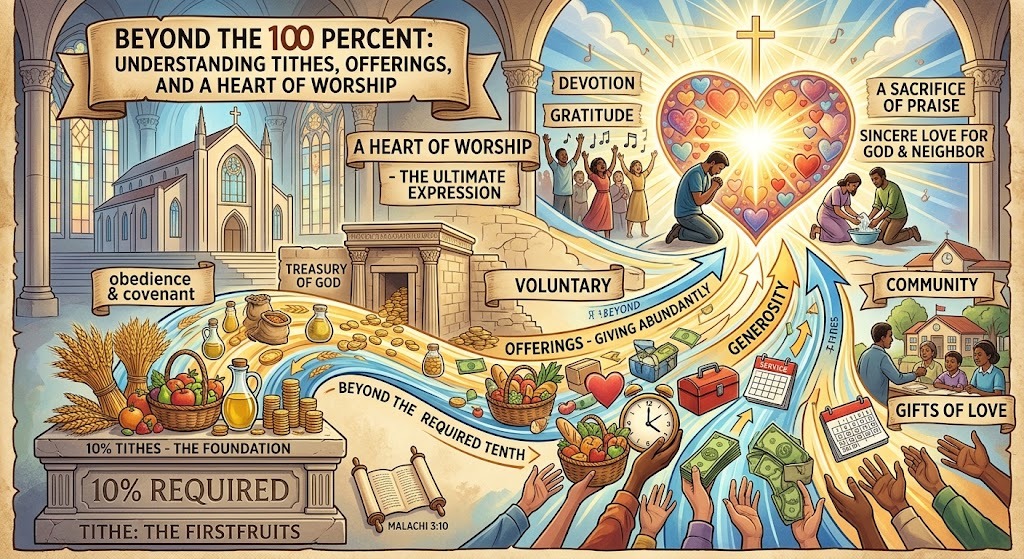
Many Christians have sat through a Sunday service and wondered what the difference actually is between a tithe and an offering. These two words get used together so often that they start to blur into one. But Scripture draws a clear line between them, and understanding that line can completely change how you think about giving.
What Does the Word "Tithe" Actually Mean?
The word tithe literally means a tenth. Throughout Scripture, the tithe represents the first 10% of your income returned to God as an act of obedience and honor. Notice the word "returned." Scripturally, we do not give a tithe. We return it.
That distinction matters. The tithe is a recognition that God owns everything. He asks for the first portion back to acknowledge His ownership. It is a baseline of trust, not a transaction.
What Does the Bible Say About Withholding the Tithe?
The prophet Malachi records one of the most direct challenges in all of Scripture on this topic:
"Should people cheat God? Yet you have cheated me! But you ask, 'What do you mean? When did we ever cheat you?' You have cheated me of the tithes and offerings due to me. Bring all the tithes into the storehouse so there will be enough food in my Temple. If you do, says the Lord of Heaven's Armies, I will open the windows of heaven for you. I will pour out a blessing so great you won't have enough room to take it in! Try it! Put me to the test!" - Malachi 3:8, 10 New Living Translation (NLT)
This passage is remarkable for one reason above all others. It is the only place in Scripture where God invites us to test Him. He is not asking for blind obedience here. He is saying, try it and see what happens.
Where Should the Tithe Go?
In the Old Testament, the tithe went to the storehouse, which was the temple. The temple was the center of spiritual life, community care, and the gathering of God's people. The priests were sustained through what was brought there. The community was cared for through it.
Today, the local church serves that same purpose. It is the gathering place, the center of spiritual life, and the hub from which ministry flows outward into the community and beyond. The tithe funds the teaching, the outreach, the care for people in need, and the practical costs of keeping the doors open and the lights on.
So What Is an Offering, and How Is It Different?
If the tithe is returning what belongs to God, an offering is anything given above and beyond that. It is a free will gift driven by gratitude, compassion, and joy. There is no set percentage. There is no ceiling.
The Apostle Paul describes the heart behind it this way:
"Remember this: A farmer who plants only a few seeds will get a small crop. But the one who plants generously will get a generous crop. You must each decide in your own heart how much to give. And don't give reluctantly or in response to pressure. For God loves a person who gives cheerfully." - 2 Corinthians 9:6-7 New Living Translation (NLT)
An offering is not something you calculate. It is something you pray about. It flows from a heart that has been moved by what God has done and wants to respond generously.
Is Tithing Just an Old Testament Rule We Can Ignore?
Some people argue that tithing belongs to the Old Testament and does not apply to followers of Jesus today. But Jesus Himself said He came to fulfill the law, not abolish it. He did not erase the principles of Scripture. He internalized them, moving them from external obligation into matters of the heart.
Understanding tithes and offerings is not about legalism. It is not a rule imposed from the outside. It is a heart posture that reflects trust in God as provider and gratitude for everything He has given.
Why Does Giving Matter Spiritually?
Giving is an act of worship. It is a spiritual discipline that breaks the grip of materialism and the tendency to place our security in what we own or earn. When we return the tithe, we are declaring that God is our provider and that we trust Him with the 90% that remains. When we give an offering, we are declaring that God has been so good to us that we cannot keep the blessing to ourselves.
There is something God builds in a person's character through the practice of generous giving. It opens your eyes to things you may never have seen before. It shifts your perspective from scarcity to abundance, from self-reliance to trust.
What About People Who Are Barely Getting By?
Scripture does not ignore the reality of financial hardship. God sees your heart. He knows your situation. The widow in the temple who gave only two small coins was honored by Jesus not because of the amount but because of what it represented. She gave all she had, and He said her love for God surpassed those who gave large amounts from their surplus.
The point is never the dollar amount. The point is always the heart behind it.
Giving Is Between You and God
No pastor, no church leader, and no offering plate should pressure you into giving. Paul is clear that giving must be decided in your own heart. The right approach is to pray, seek God, and ask Him what He is calling you to do. That conversation belongs to you and Him alone.
The church has a responsibility in return. Those who steward the finances of a local church must be transparent, accountable, and faithful with what is entrusted to them. Generosity from the congregation and good stewardship from leadership go hand in hand.
Giving Goes Beyond the Church Walls
An offering is not limited to what happens inside a church building. It can be buying someone's groceries, filling a gas tank for a family in need, gathering clothes for someone who lost everything, or supporting a ministry that reaches people far beyond your local community. When God prompts your heart to act, that response is an offering too.
The church is meant to be a lighthouse, not just for those who walk through its doors, but for the broken and the lost wherever they are found.
Life Application
This week, set aside a quiet moment with just you and God. No agenda, no pressure. Simply ask Him where your heart is when it comes to giving, and whether He is calling you to take a step of obedience, trust, or generosity that you have been putting off.
Here are a few questions to sit with:
- Have I ever truly understood the difference between a tithe and an offering, and does that change how I think about giving?
- Am I giving out of obligation and routine, or out of genuine trust and gratitude toward God?
- Is there an area of my finances where I have been holding back from God, and what would it look like to trust Him with that this week?
- Beyond money, is there a way I can give generously of my time, energy, or resources to someone in need right now?
The challenge this week is simple but not easy. Take one concrete step of generosity that requires trust. It might be starting your tithe for the first time. It might be giving an offering toward a specific need. It might be buying a stranger's meal or showing up for someone who needs help. Whatever it is, do it prayerfully, do it cheerfully, and watch what God does with a heart that is open and willing.
-
Location
Contact
Office Hours
Menu
About